


Tutorials on ASP.NET Core, Blazor, jQuery, JavaScript, Entity Framework, Identity, WordPress, SQL, HTML & more
Views in ASP.NET Core
ASP.NET Core Views create the UI for the app. Views are files with .cshtml extension. A View file contains HTML and Razor markups for creating the design for the UI. Views can be 3 main types:
- Views preciously for single Action methods
- Shared Views - that are shared between different controllers.
- Layouts - to provide consistent design for the app.
- Partial views - to reduce code duplication.
- View components - to reduce code duplication and also allow code to run on the server for rendering the webpage.
jQuery toggleClass Method – .toggleClass() Tutorial

If you want to toggle between adding and removing classes from selected elements then use the jQuery toggleClass method.
Note that if an element does not have a particular class then this method will add that class to the element.
(more…)Actions in ASP.NET Core
ASP.NET Core Action Methods are public methods defined inside the Controllers. These methods are mapped to incoming requests made from the client through routing rules.
(more…)Controllers in ASP.NET Core
Controllers are the brain of an ASP.NET Core application. They process incoming requests, perform operations on data provided through Models, and selects Views to render on the browser. Controllers are stored inside the Controllers folder in the root of the app. They are basically C# classes whose Public methods are called as Action Methods. These Action Methods handle the HTTP requests and prepare the response to be sent to the clients.
(more…)Dependency Injection in ASP.NET Core
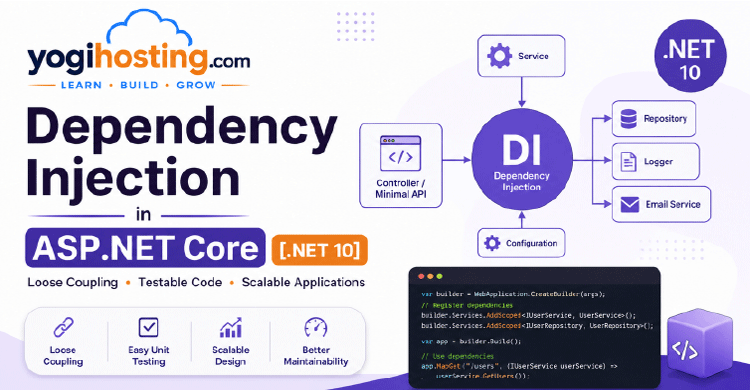
What is Dependency Injection in ASP.NET Core? Dependency Injection (shortform "DI") is an ASP.NET Core technique to achieve loosely coupling between objects so that the applications can be maintained in an easy manner. Here DOT NET runtime engine automatically injects objects of dependency classes mainly through the constructor of the Controllers. Thus making the job of the developer much easier.
Let us create a ASP.NET Core 6.0 app to demonstrate the working of Dependency Injection feature. I will give you the complete knowledge of this feature in this tutorial so make sure you read it fully on one go.
(more…)ASP.NET Core Configurations – Program.cs Middleware AppSettings
The ASP.NET Core Configurations settings are configured on 3 files:
- The Project File also known as ".csproj" file.
- Program.cs
- appsettings.json
These configuration settings tell the ASP.NET Core app how it should work based on the users interaction. In this tutorial we will look into the various ASP.NET Core Configurations which will provide you with a solid foundation for understanding the coming DOT NET Core topics. I will start by creating a new project using empty template so that you can clearly understand how each of the configuration settings work.
(more…)First CRUD Application in ASP.NET Core MVC 10.0 [Detailed & Illustrative]
In this tutorial we will create an ASP.NET Core CRUD operations Example. I will create an Employee form which can be filled and submitted. On submission, the employee information will be stored in a repository. Other than that we will also have Read, Update & Delete operations for the employee.
(more…)First ASP.NET Core 10.0 MVC Application
In this ASP.NET Core Tutorial you will create your first application in Visual Studio 2022.
(more…)Introduction to ASP.NET Core MVC
ASP.NET Core MVC is Microsoft’s Web Application development framework that is in great demand today. It is based on Model-View-Controller (MVC) architecture, ideas and techniques from Agile Development, and the best parts of .NET platform. In this tutorial I will introduce you with ASP.NET Core MVC.
(more…)How to integrate Google login feature in ASP.NET Core Identity

ASP.NET Core Identity External Login through Third-Party like Google, Facebook, Microsoft and Twitter is easy to integrate. Here we will create a feature that will allow users to Login to Identity with their Google credentials.
(more…)Please Consider Donating us
We are helping millions of Beginners and Professionals to learn new programming technologies.
Please consider donating us:




HELLO EVERYONE
 Welcome to YogiHosting - A Programming Tutorial Website. It is used by millions of people around the world to learn and explore about ASP.NET Core, Blazor, jQuery, JavaScript, Docker, Kubernetes and other topics.
SUBSCRIBE TO NEWSLETTER
Enter your email address to subscribe to this blog and receive notifications of new posts by email.
Join 90K other subscribers